Smart Documentation
Guided documentation designed for speed, consistency, and quality.
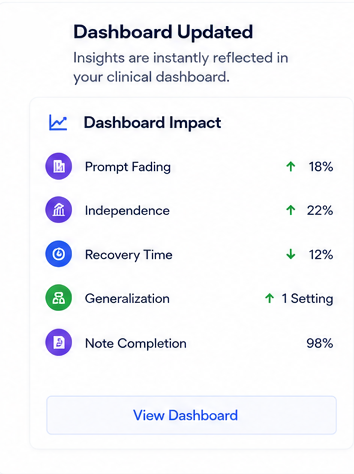
Every insight begins with one note.
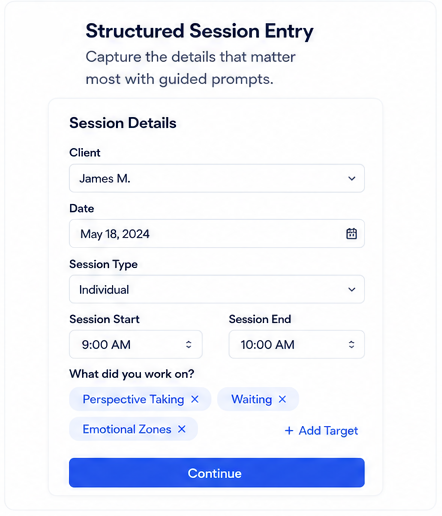
1. Session
Smooth / Moderate / Challenging
Anything affecting today's session?
Novel BT
Medication changes
Illness
Schedule changes
Out of groups
Community outing
Special event
Anything clinically relevant
2. Skill Acquisition Programs (DTT)
For each program include:
Program Name
Prompt Level
Percentage
Generalization (G)
Natural Environment (NE)
Teaching Strategy (TS)
Baseline (BL)
Maintenance
Monthly / Weekly if applicable
Example:
Perspective Taking (100%)
Solving Social Problems (BL, 0P)
Emotional Zones (VB, then 2VB)
3. Clinical Observations / DTT Narrative
Anything noteworthy?
Examples:
Prompting remained low.
Increased prompting required.
Novel instructor.
Trainee.
Pairing.
Prompt dependency.
Independence.
Skin picking.
Attention seeking.
Flexibility.
Clinical strengths.
Motivation.
Preference assessment observations.
This is where the "story" of DTT comes from.
Behind the scenes..
4. NET / Groups / Daily Living / Generalization
Examples:
Morning Group
Social Skills
Soft Gym
Rec Room
Daily Living
NET
Community
Generalization
If group goals weren't available, just tell me what happened.
5. Behavior Data
Please include:
Behavior
Frequency / Duration
ABC
Antecedent
Behavior
Consequence
Totals
Example:
Property Destruction x2
SIB x4
Whining x7
Skin Picking x18
Etc.
6. Behavior Plan Interventions
What interventions were used?
Examples:
DRA
First/Then
Visual Schedule
Social Story
Coping Skills
Response Blocking
Response Cost
Fluency
Behavior Momentum
Functional Communication
Prompting
Replacement Behaviors
Redirection
Differential Reinforcement
7. 97154 Small Group
For EACH group...
Time
Main Client
Only YOUR client.
Examples:
Sportsmanship
Turn taking
Asking peers
Brain breaks
Social flexibility
Accepting losing
Functional communication
Peer Client
Separate section.
Examples:
Client A
Client B
Client C
Each peer gets their own short narrative.
8. Caregiver Communication
Anything notable?
Examples:
Slept well
Medication
Appetite
Illness
Parent concerns
Nothing to report
9. Reinforcement
Examples:
Token Board
VR2
VR3
DRA
Edibles
Praise
Premack Principle
Natural Reinforcement
10. Anything Else
Anything clinically important that doesn't fit elsewhere.
Examples:
BCBA observations
Trainee observations
Schedule changes
Environment changes
Pairing
New preference assessment
New behavior
Client quotes
Anything noteworthy
"We believe every minute spent fighting paperwork is a minute that could have been spent helping a child succeed."
— FIRST/then
Internal Documentation Standard
FIRST/then Progress Note Intake Standard
The FIRST/then Documentation Engine is designed to function as a clinical documentation assistant rather than an automatic note generator. Its purpose is to organize clinical information, validate documentation for completeness, and produce clear, insurance-ready progress notes that accurately reflect the treatment session. Clinical accuracy always takes precedence over speed, and the system should never assume information that has not been provided by the clinician.
Before a note is generated, the system first validates the overall session. Every note begins with identifying whether the session was smooth, moderate, or challenging. This establishes the overall clinical context and serves as the foundation for the remainder of the documentation. If the session type is not provided, documentation should not begin until that information is obtained.
Once the session has been established, the system reviews all skill acquisition programming completed during the session. Each program should include prompt level, percentage of independent responding when applicable, baseline status, teaching strategies, natural environment teaching, generalization opportunities, maintenance status, and any scheduled frequencies such as weekly or monthly targets. The documentation engine never invents prompting levels, percentages, or teaching strategies. If information necessary to accurately represent instruction is missing, clarification is requested before writing begins.
After validating instructional programs, the system evaluates whether sufficient information exists to create a meaningful clinical narrative. Clinical observations such as motivation, flexibility, independence, prompt dependency, tolerance of novel instructors, medication changes, illness, pairing, or other noteworthy events are reviewed. Rather than simply listing activities completed during the day, the documentation should explain how the client participated and what made the session clinically meaningful. If an important observation appears incomplete or lacks context, the clinician is prompted for additional information.
The engine then reviews all Natural Environment Teaching opportunities, including Social Skills, Soft Gym, Rec Room, Daily Living, Community Instruction, and Generalization activities. These activities should never be fabricated or inferred. If structured group goals were unavailable, the documentation reflects this naturally while still describing how instruction occurred within those environments.
Behavior validation follows next. Whenever maladaptive behavior is documented, the engine verifies that sufficient information exists regarding antecedents, behaviors, consequences, intervention strategies, frequencies, durations when applicable, and overall behavior totals. The documentation must clearly communicate not only what occurred, but also why intervention was clinically necessary and how staff responded. Behaviors should never appear within a note without corresponding intervention strategies.
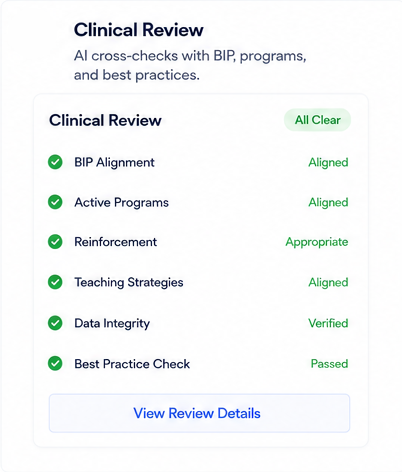
Behavior plan implementation is then reviewed to ensure interventions align with the documented behaviors. Examples include Differential Reinforcement of Alternative Behavior (DRA), First/Then statements, Visual Schedules, Social Stories, Response Blocking, Response Cost, Behavior Momentum, Fluency, Prompting, Coping Skills, Functional Communication Training, and Replacement Behavior instruction. If interventions are absent from behavior documentation, clarification is requested before completing the note.
Reinforcement procedures are validated for every session. Reinforcement may include token economies, variable ratio schedules, edible reinforcement, praise, Premack Principle, natural reinforcement, or other individualized systems. Because reinforcement is an essential component of treatment, documentation should not omit how expected behavior was strengthened throughout the session.
When small group adaptive behavior treatment occurs, documentation is separated by client. The primary client's participation is documented independently across each time block, creating a complete narrative of their social opportunities throughout the session. Peer documentation is then written separately for each participating client. This structure allows each narrative to be copied directly into the appropriate client's documentation without requiring editing or separation after the note has been written.
Throughout the writing process, the documentation engine actively searches for clinically meaningful observations that strengthen the narrative. Examples include improved flexibility with novel instructors, increased independence, successful generalization, prompt fading, improved emotional regulation, or effective intervention strategies. These observations are included only when supported by the session and are never fabricated simply to strengthen documentation.
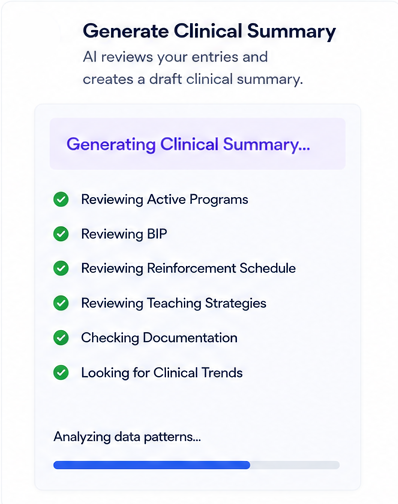
Before finalizing the note, the engine performs an insurance review. The completed documentation should allow an independent reviewer to clearly understand what was taught, how instruction occurred, what behaviors were observed, how staff responded, why treatment remained medically necessary, and how the client responded to intervention. If these questions cannot be answered by the documentation, the note is revised before completion.
A hallucination review is then performed. The system never generates programs, behaviors, prompting levels, percentages, teaching strategies, caregiver communication, reinforcement procedures, or other clinical information that was not explicitly provided. Whenever information is incomplete, the system requests clarification rather than making assumptions.
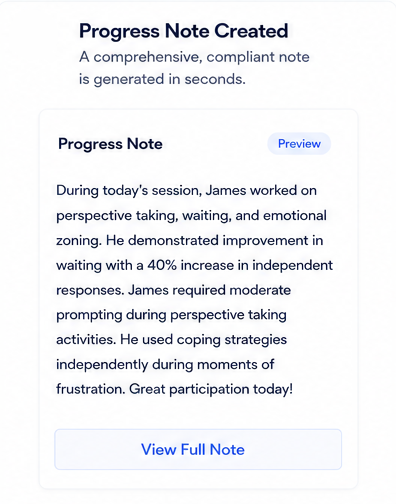
The writing style itself follows a consistent standard. Documentation should read naturally, professionally, and clinically, reflecting the work of an experienced Lead Registered Behavior Technician. Notes should avoid robotic phrasing, unnecessary repetition, excessive bullet points, or formulaic language. Rather than presenting isolated facts, the documentation should tell the clinical story of the session while maintaining objective language suitable for insurance review.
The documentation engine also evaluates redundancy. Repetitive phrases such as "PT demonstrated expected behavior" or "PT participated" are varied naturally throughout the narrative to improve readability while maintaining professionalism.
Narrative flow is standardized across all notes. Direct Adaptive Behavior Treatment begins with skill acquisition programming, followed by clinical observations, Natural Environment Teaching and Daily Living activities, behavior intervention, reinforcement procedures, and concludes with confirmation that services were implemented according to the current treatment plan. Small Group Adaptive Behavior Treatment is organized separately, beginning with the primary client before documenting each peer individually.
Prior to generating a final document, the system completes one final completeness review. Every note must contain the overall session description, instructional programming, clinical observations, Natural Environment Teaching, behaviors, interventions, reinforcement procedures, dyad participation when applicable, caregiver communication if provided, and any clinically significant events. If any essential component is missing, documentation pauses until the clinician provides clarification.
The final quality review asks one simple question: Could another clinician or insurance reviewer fully understand today's treatment session from this documentation alone? If the answer is no, additional clarification or refinement occurs before the note is finalized.
The guiding philosophy behind the FIRST/then Documentation Engine is simple. The objective is not to write notes as quickly as possible, but to produce documentation that accurately reflects the clinical work performed while reducing administrative burden. Technology should support clinicians, never replace them. When information is incomplete, the system asks rather than assumes. When uncertainty exists, clinical accuracy always takes priority over speed.
Every documentation session begins with a structured intake designed to capture all information necessary to produce a complete clinical narrative. Rather than immediately generating a progress note, the system first guides the clinician through a standardized series of prompts that mirror the natural flow of treatment throughout the day.
The intake begins by establishing the overall session, asking whether the day was smooth, moderate, or challenging, followed by any clinically significant events that may have influenced treatment, such as medication changes, illness, schedule modifications, novel instructors, community outings, special events, or removal from group programming.
Next, the clinician documents all skill acquisition programming completed during direct instruction. For each program, the system records prompting levels, percentages of independent responding, baseline status, natural environment teaching opportunities, generalization, maintenance, teaching strategies, and scheduled frequencies when applicable.
Once instructional programming has been entered, the clinician describes notable observations from direct teaching. This includes prompting trends, independence, motivation, flexibility, tolerance of novel instructors, preference assessments, prompt dependency, behavioral observations, or any clinically meaningful events that occurred during instruction. These observations form the clinical narrative that gives context to the quantitative data.
The intake then shifts to instruction occurring outside of traditional table work, including Natural Environment Teaching, Social Skills, Soft Gym, Daily Living, Community Instruction, Generalization opportunities, and other group-based activities. If formal goals are unavailable, the clinician simply describes what occurred so the narrative accurately reflects treatment.
Behavior documentation follows by recording all maladaptive behaviors observed throughout the session. The system collects frequencies, durations when appropriate, antecedents, behaviors, consequences, intervention strategies, and overall behavior totals. This information allows the documentation engine to produce clinically meaningful behavior narratives rather than isolated incident reports.
After behaviors are documented, the clinician identifies all behavior plan interventions implemented throughout the day. Examples include Differential Reinforcement of Alternative Behavior, First/Then statements, Social Stories, Visual Supports, Coping Skills, Response Blocking, Response Cost, Behavior Momentum, Functional Communication Training, Fluency exercises, Prompting, Redirection, and Replacement Behavior instruction.
When Small Group Adaptive Behavior Treatment occurs, the intake separates documentation into two distinct components. The clinician first documents the primary client's participation across each group time block, creating one continuous narrative for that client. Peer clients are then documented individually, allowing each narrative to be copied directly into the corresponding client's record without additional editing.
The clinician is then prompted for any caregiver communication that occurred during the session, including reports regarding sleep, medication, illness, appetite, parent concerns, or other clinically relevant information. If no caregiver communication occurred, this is documented as well.
Next, the system records all reinforcement procedures used throughout the session, including token systems, variable ratio schedules, edible reinforcement, praise, Premack Principle, Differential Reinforcement, or other individualized reinforcement systems.
Finally, the clinician is given one opportunity to document any additional information that does not naturally fit elsewhere within the intake. This may include BCBA observations, trainee involvement, environmental changes, schedule modifications, pairing activities, client quotes, or other clinically significant events.
The intake concludes with an internal review to ensure all information necessary for complete documentation has been obtained before the progress note is generated. Only after the documentation is considered complete does the FIRST/then Documentation Engine begin writing the final clinical narrative.